| HOME |
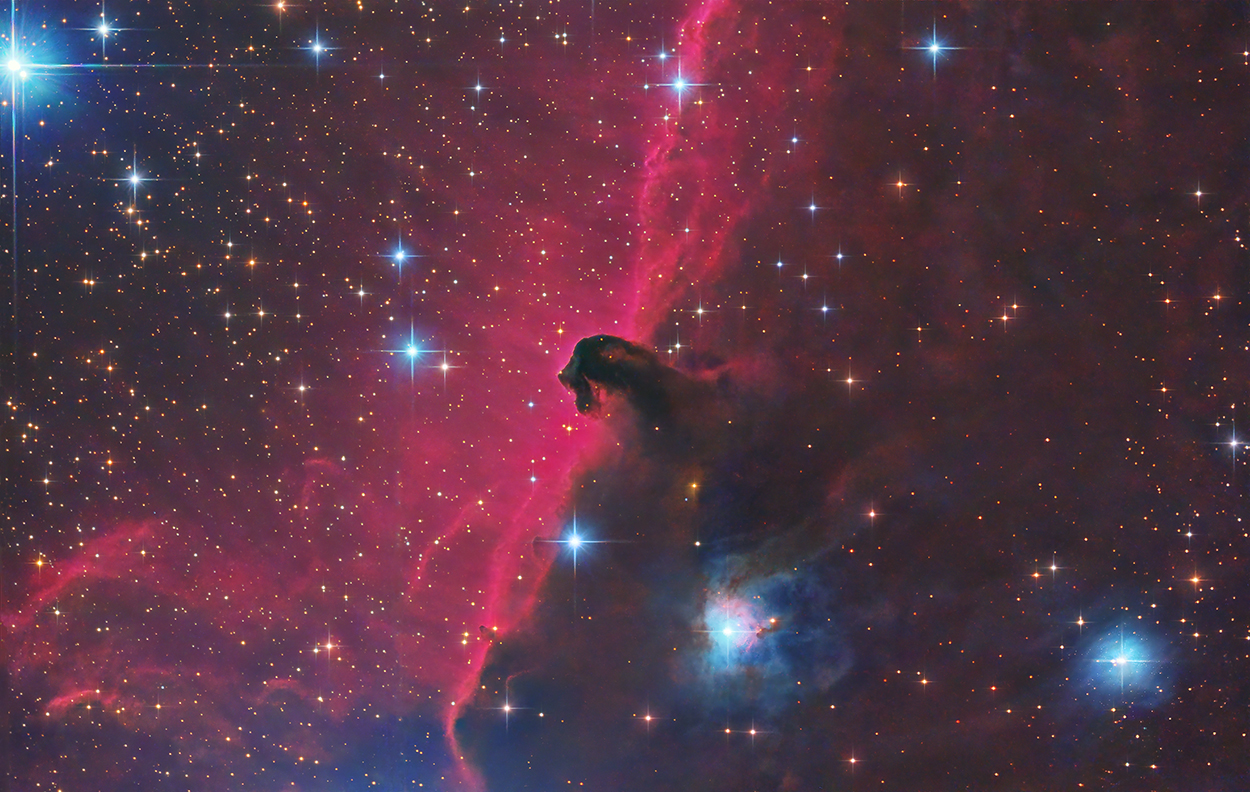
HORSE HEAD NEBULA COMPLEX - AKA BARNARD 33 & IC 434
DARK AND EMISSION NEBULA IN ORION (THE HUNTER)
(Image centered at: ra 05h:40 m 59 s / dec - 02º 27' 30")
CLICK THE IMAGE FOR A HIGH RESOLUTION VIEW
ANNOTATED IMAGE 50% RESOLUTION
November 2025, Observatorio Cielos Albertnos, Buenos Aires, Argentina
DATA
TYPE: Dark and Emission Nebula Complex
APPARENT DIAMETER FOR BARNARD 33: 8 X 6 arc minutes
APPARENT MAGNITUDE (V): n/a
DISTANCE: 1375 light years
IMAGE INFORMATION
INSTRUMENT: Orion Optics UK 6" Newtonian with Ultra Grade Optics working at f 4.5
CAMERA: QHY 183 Mono Camera
MOUNT: VIXEN GPDX Guided off axis with QHY 5II Mono Camera
FILTERS: OPTOLONG LRGB Set & Antlia Ha 3nm O3 3nm
SKY CONDITIONS: Bortle 3 skies
OBJECT DESCRIPTION AND IMAGE SESSION
The Horsehead Nebula (also known as Barnard 33 or B33) is a small dark nebula located about 1,375 light-years (or 422 parsecs) from Earth in the constellation of Orion. The nebula is located just to the south of Alnitak, the easternmost star of Orion's Belt, and is part of the much larger Orion molecular cloud complex. It appears within the southern region of the dense dust cloud known as Lynds 1630, along the edge of the much larger, active star-forming H II region called IC 434. It is one of the most identifiable nebulae because of its resemblance to a horse's head. The remarkable Horse Head Nebula is a dark cloud of dust and gas which presents a particular shape. B33 stands in front of emission nebula IC 434 blocking its light. The height of B33 covers a distance of five light years and it can only be seen through photographs or special filters in dark skies.
Also visible to the lower part of the Horse Head NGC 2023 which appears as a "light blue rose" and to the right and a bit small IC 435; both are reflection nebulae and fantastic objects as well but of course, overwhelmed by the magnificence of Barnard 33 and IC 434.
This nebula was discovered by Scottish astronomer Williamina Fleming in 1888 on a photographic plate taken at the Harvard College Observatory. One of the first descriptions was made by American astronomer Edward Emerson Barnard, was: "Dark mass, diameter 4 arc minutes, on nebulous strip extending south from ζ Orionis", cataloguing the dark nebula as Barnard 33.
HORSE HEAD NEBULA COMPLEX - AKA BARNARD 33 & IC 434
ANNOTATED IMAGE 50% RESOLUTION
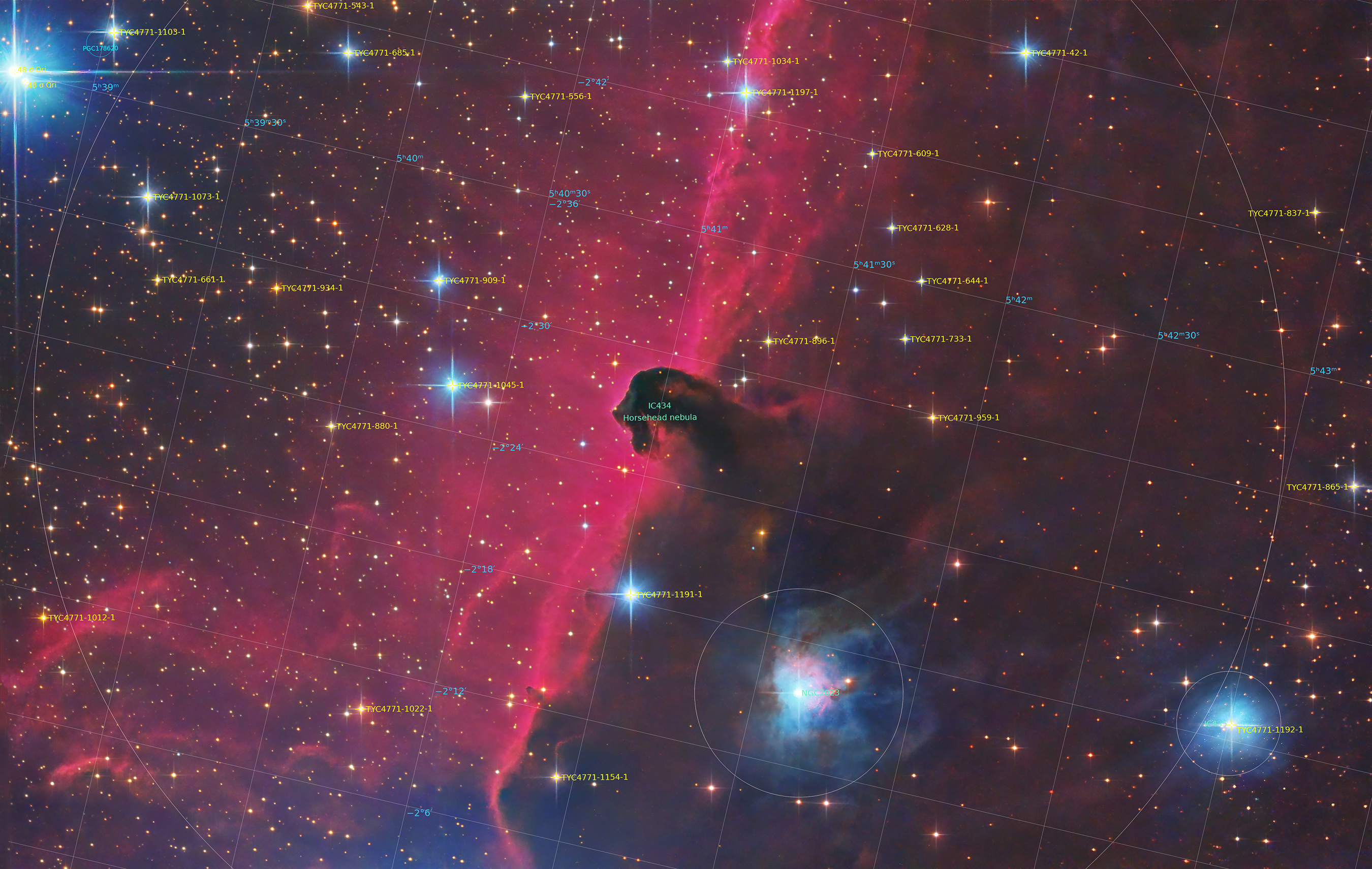
Image Plate Solver script version 5.6.2
===============================================================================
Referentiation matrix (world[ra,dec] = matrix * image[x,y]):
 +1.96177240e-04  +4.83729140e-05  -6.32867370e-01
 -4.83046281e-05  +1.96270664e-04  -2.27627653e-01
WCS transformation ....... Linear
Projection ............... Gnomonic
Projection origin ........ [2771.816256 1841.942135] px -> [RA:  5 41 09.701  Dec:  -2 26 22.10]
Resolution ............... 0.728 arcsec/px
Rotation ................. -166.176 deg
Reference system ......... ICRS
Observation start time ... 2025-11-24 04:38:07 UTC
Observation end time ..... 2025-11-24 04:41:07 UTC
Geodetic coordinates .....  58 50 00 W  34 48 03 S
Focal distance ........... 680.44 mm
Pixel size ............... 2.40 um
Field of view ............ 1d 7' 13.4" x 44' 40.2"
Image center ............. RA:  5 41 09.710  Dec:  -2 26 22.09
Image bounds:
   top-left .............. RA:  5 38 37.656  Dec:  -2 40 00.97
   top-right ............. RA:  5 42 58.975  Dec:  -2 56 05.26
   bottom-left ........... RA:  5 39 20.526  Dec:  -1 56 38.36
   bottom-right .......... RA:  5 43 41.714  Dec:  -2 12 42.14