| HOME |
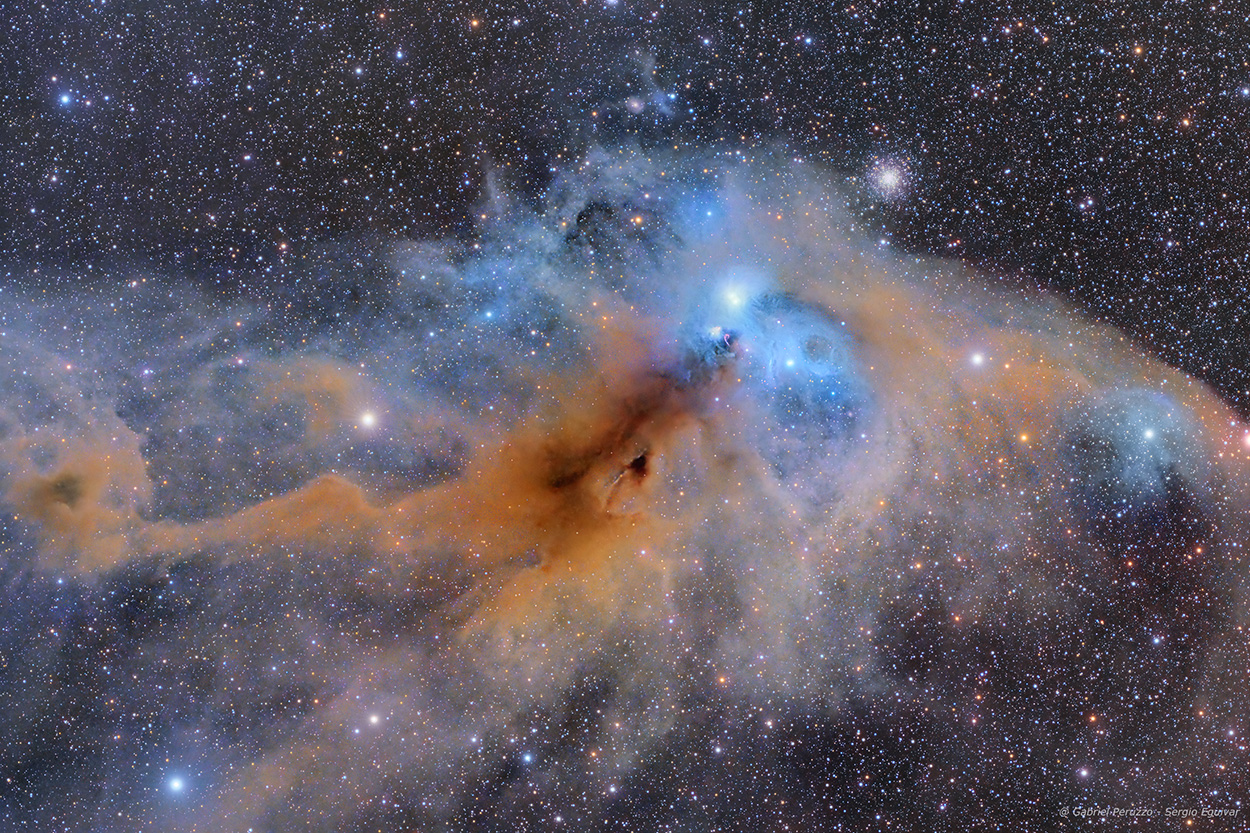
CORONA AUSTRALIS MOLECULAR CLOUD
WIDE FIELD AREA - COLLABORATION WITH GABRIEL PERUZZO
(Image centered at: ra 19h:03 m / dec -36º 54')
CLICK THE IMAGE FOR A HIGH RESOLUTION VIEW
Collaboration with Gabriel Peruzzo image acquisition
AUGUST 2026, Observatorio Cielos Albertnos, Buenos Aires, Argentina
DATA
TYPE: MOLECULAR CLOUD DUST COMPLEX
APPARENT DIAMETER: FOV 3 degrees coverage
APPARENT MAGNITUDE (V): NA
DISTANCE: between 425 to 450 light years
IMAGE INFORMATION
INSTRUMENT: William Optics Ulta Cat 56
CAMERA: ASI ZWO 2600MC AIR
EXPOSURES: 163 X 180 seconds. 8 hours 9 minutes exposure time
MOUNT: ZWO AM5
FILTERS: None
SKY CONDITIONS: Bortle 3 skies
OBJECT DESCRIPTION AND IMAGE SESSION
The Corona Australis molecular cloud is located at a distance of 130 parsecs (~430 ly),[2][3]. It is a dark nebula of gas and dust and is one of the nearest star formation regions from Earth. Sometimes referred to as the CrA Dark Cloud or the CrA Cloud, it hosts several reflection nebulae − NGC 6729, NGC 6726/6727, and IC 4812 being the most notable. The globular cluster known as NGC 6723, which appears close by, is actually 29,000 light years away, and so not part of the region. The cloud is located in the constellation Corona Australis, close to the border with Sagittarius, between Gamma Coronae Australis and Epsilon Coronae Australis and stretches roughly 8 light years across.
Temperatures of the cloud ranges from 13–22 K, and there is a total of about 7,000 times the mass of the Sun in material. Over half of the mass of the complex is concentrated around a small area, and this is the most active star-forming region. There are embedded infrared sources within the complex. A total of 425 infrared sources have been detected near the L1688 cloud. These are presumed to be young stellar objects,