| HOME |
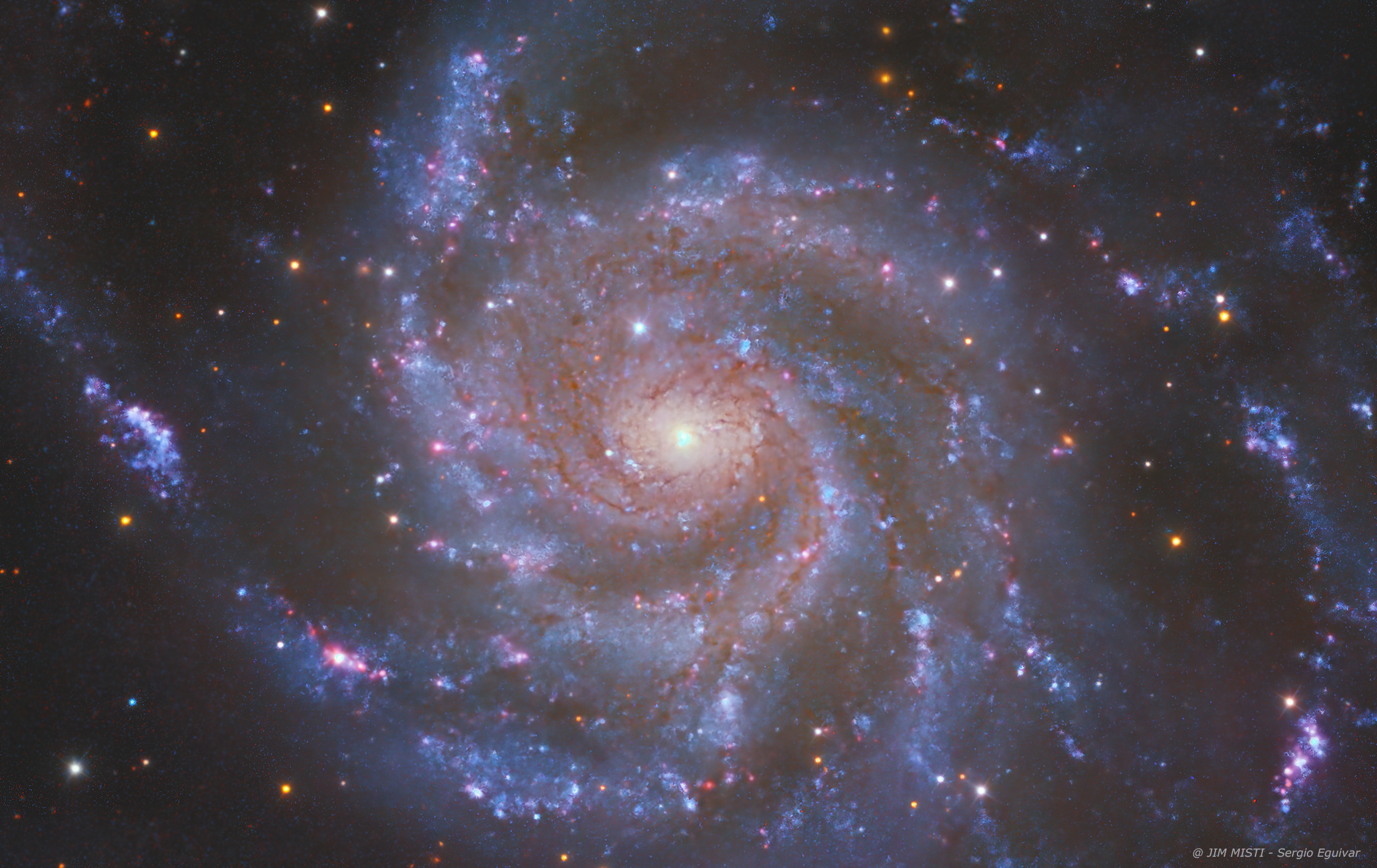
MESSIER 101
SPIRAL GALAXY IN URSA MAJOR
(Image Centred at ra 14h:03m / dec +54:21)
Image data acquired by Jim Misti, Image processing by Sergio Eguivar
Arizona, USA
DATA
Type: Spiral Galaxy
Apparent Magnitude:7.9
Apparent diameter: 26.9 arc minutes
Distance: 25 Million light years
IMAGE INFORMATION
Optics: Ritchey-Chretien 32" f 7.2 Telescope
CAMERA: SBIG STL 11000
SKY CONDITIONS: Dark Skies
EXPOSURES: LRGB (60,15,15,15)
OBJECT DESCRIPTION AND IMAGE SESSION
The Pinwheel Galaxy (also known as Messier 101, M101 or NGC 5457) is a face-on, counterclockwise intermediate spiral galaxy located 25 million light-years (6.4 megaparsecs) from Earth in the constellation Ursa Major. It was discovered by French astronomer Pierre Méchain in 1781 and was communicated that year to Charles Messier, who verified its position for inclusion in the Messier Catalogue as one of its final entries. About 170,000 light-years across, this galaxy is enormous, almost twice the size of our own Milky Way
Pierre Méchain, the discoverer of the galaxy, described it as a "nebula without star, very obscure and pretty large, 6' to 7' in diameter, between the left hand of Bootes and the tail of the great Bear. It is difficult to distinguish when one illuminates the [grating] wires." William Herschel wrote in 1784 that the galaxy was one of several which "...in my 7-, 10-, and 20-feet [focal length] reflectors shewed a mottled kind of nebulosity, which I shall call resolvable; so that I expect my present telescope will, perhaps, render the stars visible of which I suppose them to be composed."
Another image kindly offered by Jim Misti for processing. Messier 101 is one of the northern hemisphere gems. Although the integration time was a bit short it is always nice to process this image coming from top notch equipment and beautiful northern dark skies.
Thanks Jim !!