| HOME |
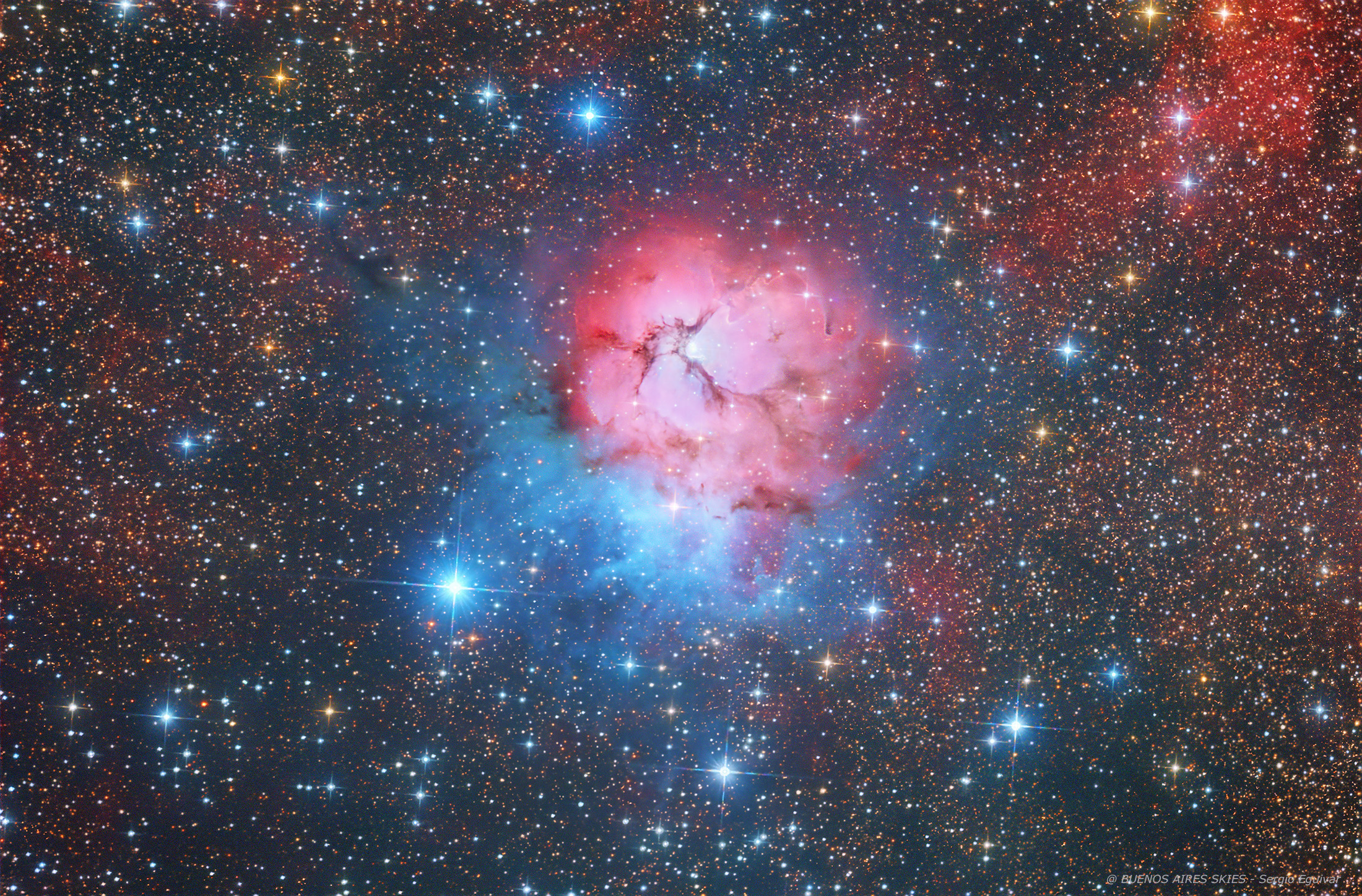
MESSIER 20
EMISSION AND REFLEXION NEBULA IN SAGITTARIUS (THE ARCHER)
(Image centered at: ra 18h:02 m / dec -23º 01')
AUGUST 2026, Observatorio Cielos Albertnos, Buenos Aires, Argentina
DATA
TYPE: Emission and Reflexion Nebula
APPARENT DIAMETER: 28 arc minutes
APPARENT MAGNITUDE (V): 6.3
DISTANCE: 4.100 light years
IMAGE INFORMATION
INSTRUMENT: Orion Optics UK 6" Newtonian with Ultra Grade Optics working at f 4.5
CAMERA: QHY 183 Mono Camera
MOUNT: SKY WATCHER NEQ6 Guided off axis with QHY 5II Mono Camera
FILTERS: Antlia LRGB Set Ha Antlia 3.5 nm
SKY CONDITIONS: Bortle 3 to 4 skies
OBJECT DESCRIPTION AND IMAGE SESSION
The Trifid Nebula (catalogued as Messier 20 or M20 and as NGC 6514) is an H II region in the north-west of Sagittarius in a star-forming region in the Milky Way's Scutum–Centaurus Arm. It was discovered by Charles Messier on June 5, 1764. Its name means 'three-lobe'. The object is an unusual combination of an open cluster of stars, an emission nebula (the relatively dense, reddish-pink portion), a reflection nebula (the mainly NNE blue portion), and a dark nebula (the apparent 'gaps' in the former that cause the trifurcated appearance, also designated Barnard 85). Viewed through a small telescope, the Trifid Nebula is a bright and peculiar object, and is thus a perennial favorite of amateur astronomers
The Trifid Nebula was the subject of an investigation by astronomers using the Hubble Space Telescope in 1997, using filters that isolate emission from hydrogen atoms, ionized sulfur atoms, and doubly ionized oxygen atoms. The images were combined into a false-color composite picture to suggest how the nebula might look to the eye. The close-up images show a dense cloud of dust and gas, which is a stellar nursery full of embryonic stars. This cloud is about 8 light years away from the nebula's central star.