| HOME |
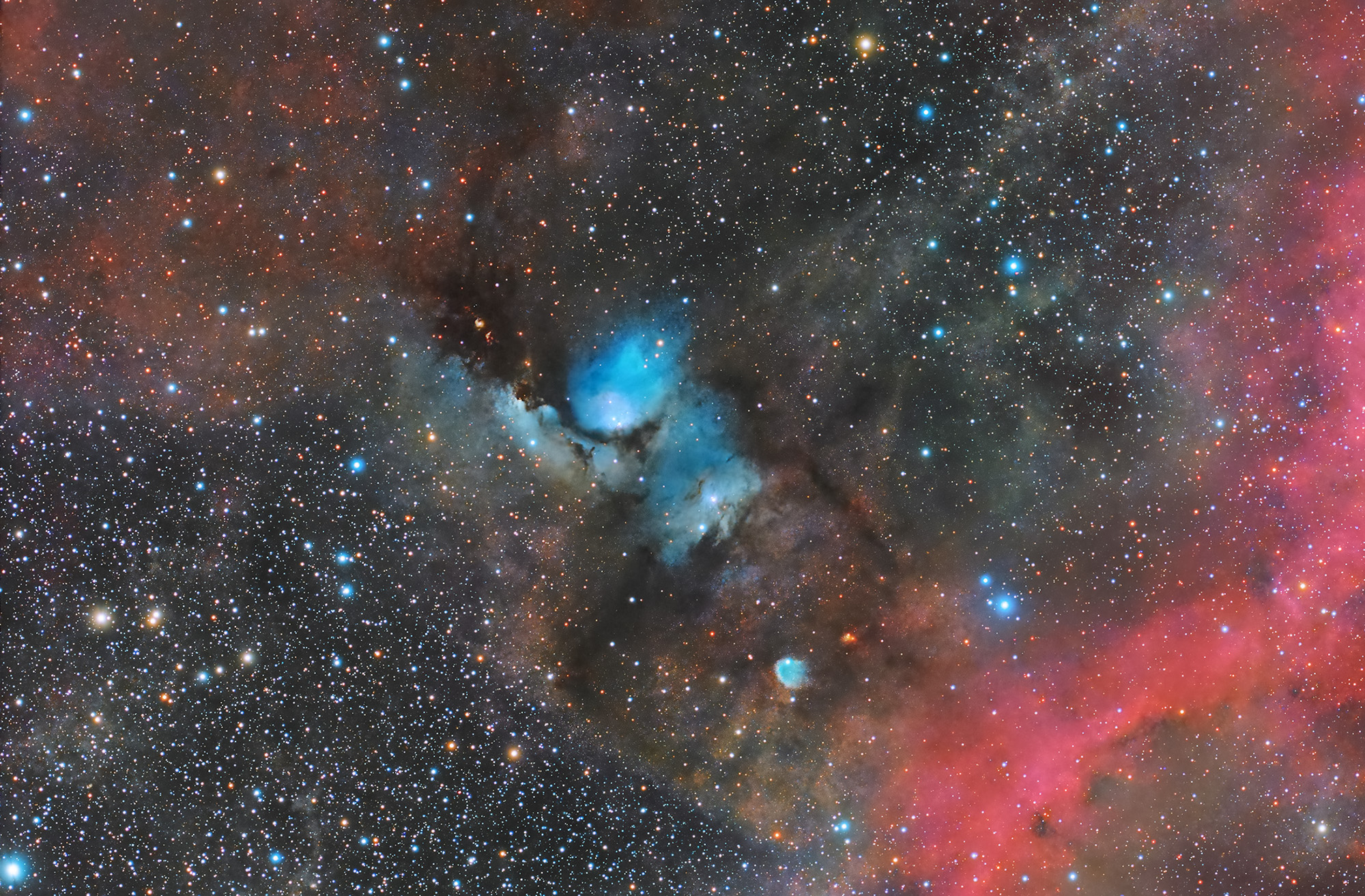
MESSIER 78
REFLECTION EMISSION AND DARK AND NEBULA IN ORION (THE HUNTER)
(Image centered at: ra 05h:46 m 46 s / dec 00º 00' 50")
COLLABORATION WITH EZEQUIEL BELLOCCHIO (IMAGE ACQUISITION)
CLICK THE IMAGE FOR A HIGH RESOLUTION VIEW
December 2025, Observatorio Cielos Albertnos, Buenos Aires, Argentina
DATA
TYPE: Reflection & Emission and Dark Nebula Complex
APPARENT DIAMETER: 8 X 6 arc minutes
APPARENT MAGNITUDE (V): 8.3
DISTANCE: 1375 light years
IMAGE INFORMATION
SCOPE: Askar SQA55 f4.8 Quintuplet Petzval
CAMERA: ZWO 2600 Color
MOUNT: ZWO AM5M
FILTERS: None
EXPOSURES: LRGB 6 HS (60 X 300 secs)
SKY CONDITIONS: bortle 3 skies
OBJECT DESCRIPTION AND IMAGE SESSION
Messier 78 (also known as M78 or NGC 2068) is a reflection nebula in the constellation Orion. It is the brightest diffuse reflection nebula in a group that includes NGC 2064, NGC 2067, and NGC 2071, all part of the Orion B molecular cloud complex. Located approximately 1,350 light-years from Earth,[2] M78 is visible in small telescopes as a hazy patch illuminated by two B-type stars, HD 38563 A and HD 38563 B, of 10th and 11th magnitude.[4] It is a popular target for amateur astronomers, who have given it the common name Casper the Friendly Ghost Nebula.
Discovered by Pierre Méchain in 1780, M78 was included in Charles Messier's catalog of comet-like objects that same year.
The nebula's dust cloud reflects light from its two central stars, making it visible. Infrared observations reveal an embedded star cluster and a hierarchy of gas clumps with core masses ranging from 0.3 solar masses 5 solar masses.
This image is a crop of a larger filed of view that covers 5 degrees including Barnard loop Messier 78 and LDN 1622 acquired by Ezequiel Bellocchio