| HOME |
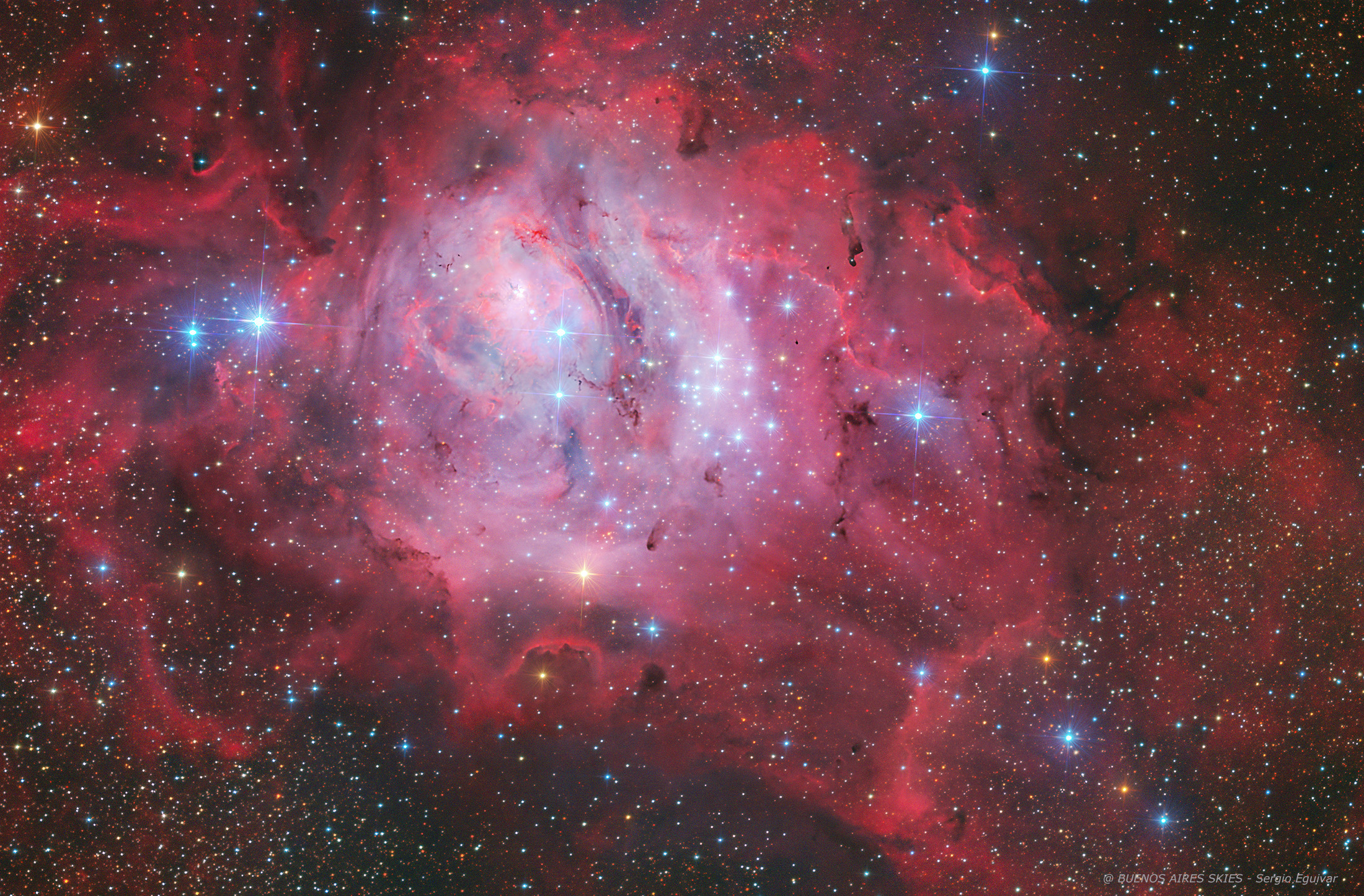
MESSIER 8
EMISSION AND REFLEXION NEBULA IN SAGITTARIUS (THE ARCHER)
(Image centered at: ra 18h:03 m / dec -24º 23')
AUGUST 2026, Observatorio Cielos Albertnos, Buenos Aires, Argentina
DATA
TYPE: Emission and Reflexion Nebula
APPARENT DIAMETER: 90 x 40 arc minutes
APPARENT MAGNITUDE (V): 4.6
DISTANCE: 4.100 light years
IMAGE INFORMATION
INSTRUMENT: Orion Optics UK 6" Newtonian with Ultra Grade Optics working at f 4.5
CAMERA: QHY 183 Mono Camera
MOUNT: SKY WATCHER NEQ6 Guided off axis with QHY 5II Mono Camera
FILTERS: Antlia LRGB Set Ha Antlia 3.5 nm
SKY CONDITIONS: Bortle 3 to 4 skies
OBJECT DESCRIPTION AND IMAGE SESSION
Located approximately 4,000–6,000 light-years from Earth, the nebula spans 110 by 50 light-years (appearing as 90' by 40' in Earth's sky). While appearing pink in long-exposure photographs, it typically appears gray when viewed through binoculars or telescopes due to the human eye's limited color sensitivity in low-light conditions. The nebula contains the young open cluster NGC 6530 within its structure. The Lagoon Nebula features several distinctive structures, including: Multiple Bok globules cataloged by E. E. Barnard (B88, B89, and B296) A funnel-shaped structure formed by ultraviolet radiation from a hot O-type star The centrally-located Hourglass Nebula (named by John Herschel).
This object has been discovered by Giovanni Battista Hodierna before 1654, and classified it as "nebulosa," i.e. of intermediate brightness. When Charles Messier cataloged this object on May 23, 1764, he primarily described the cluster, and mentioned the nebula separately as surrounding the star 9 Sagittarii.