| HOME |
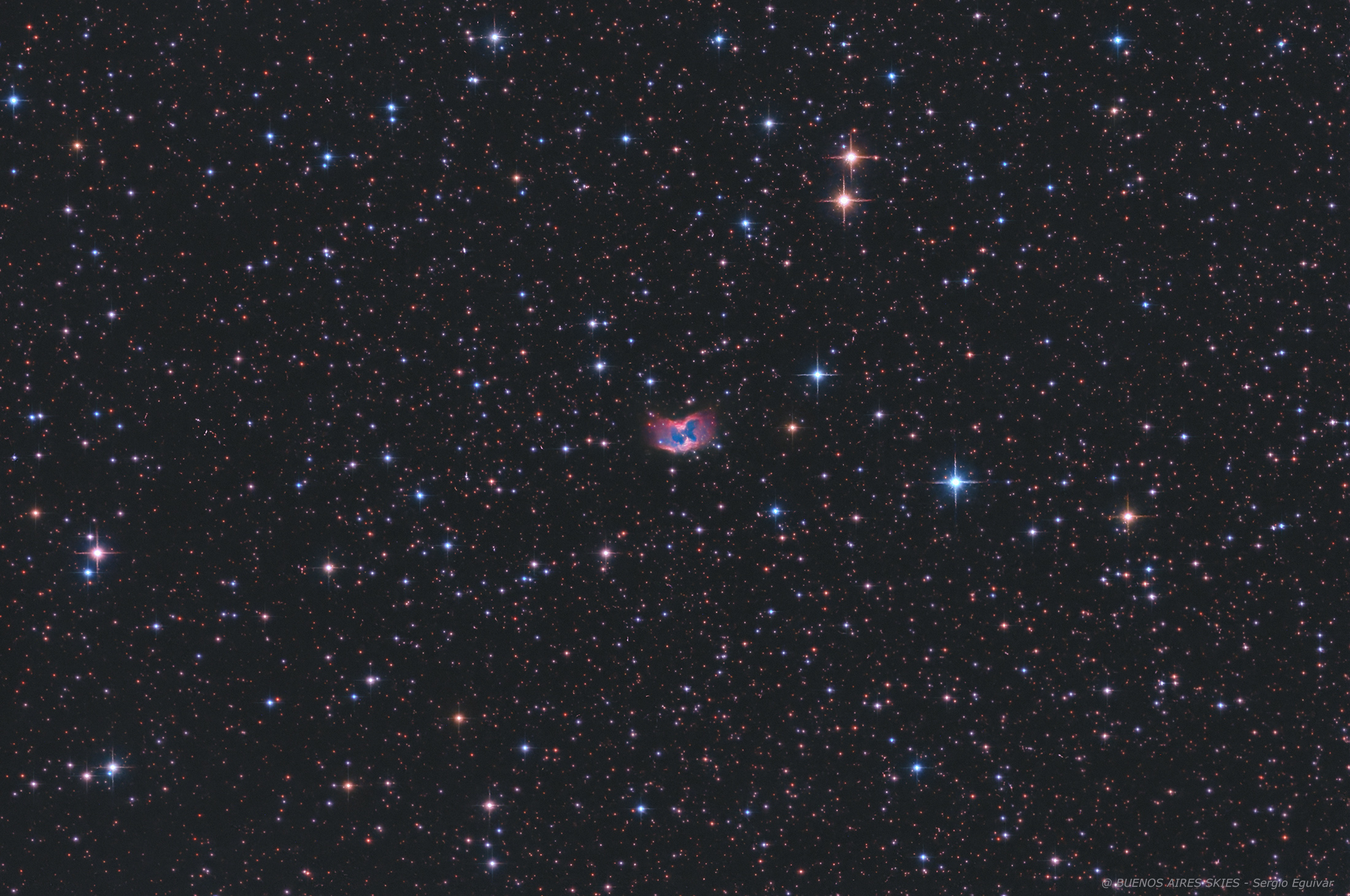
NGC 2899
PLANETARY NEBULA IN VELA (THE SAIL)
(ra: 09h 27' 03"/ dec -56º 06')
April 2026, Home Backyard in Martinez, Buenos Aires, Argentina
DATA
TYPE: Planetary Nebula
Visual Brightness: 11.8
APPARENT DIAMETER: 2.6 x 1,3 arc minutes
DISTANCE: 3350 light years
IMAGE INFORMATION
SCOPE: 6" ORION OPTICS UK (Ultra Grade Optics) w/Sky Watcher Coma Corrector (0.9x) working at at f4.5
CAMERA: QHY 183 MONO
MOUNT: VIXEN GPDX, OAG with QHY 5II Mono
FILTERS: OPTOLONG LRGB Set; Antlia Ha + O3 3nm filters
SKY CONDITIONS: Urban Skies. Bortle 9
EXPOSURES: LHAO3RGB (45,100,100,45,45,45) - all channels bin 1x1
OBJECT DESCRIPTION AND IMAGE SESSION
NGC 2899 is a planetary nebula in the southern constellation of Vela. It was discovered by English astronomer John Herschel on February 27, 1835. This nebula is quite bright and can be viewed with a moderate-sized amateur telescope, but requires a larger telescope to resolve details.
This nebula has an overall kidney shape that is elongated along an axis from West North West to East South East. The overall topology is bipolar with a significant equatorial structure. This shape is believed to result from a binary star system. The mean expansion rate is 43 to 56 km/s, with high velocity structures expanding at 110 to 130 km/s. The core mass of the central star is estimated as ~1.2 solar masses.
The nebula lies within a large cavity in the surrounding medium. This opening has quadrupolar shape with a physical dimension of 14 parsecs × 11 parcecs (1 pc = 3.26156 light years(. The elongation lies along a position angle of 37°±5°, which is aligned with the minor axis of the planetary nebula. This opening was most likely crafted by a fast stellar wind coming from the central star during its asymptotic giant branch stage, prior to the formation of a planetary nebula. The shape and filamentary structures suggest the interaction of a binary star system.