| HOME |
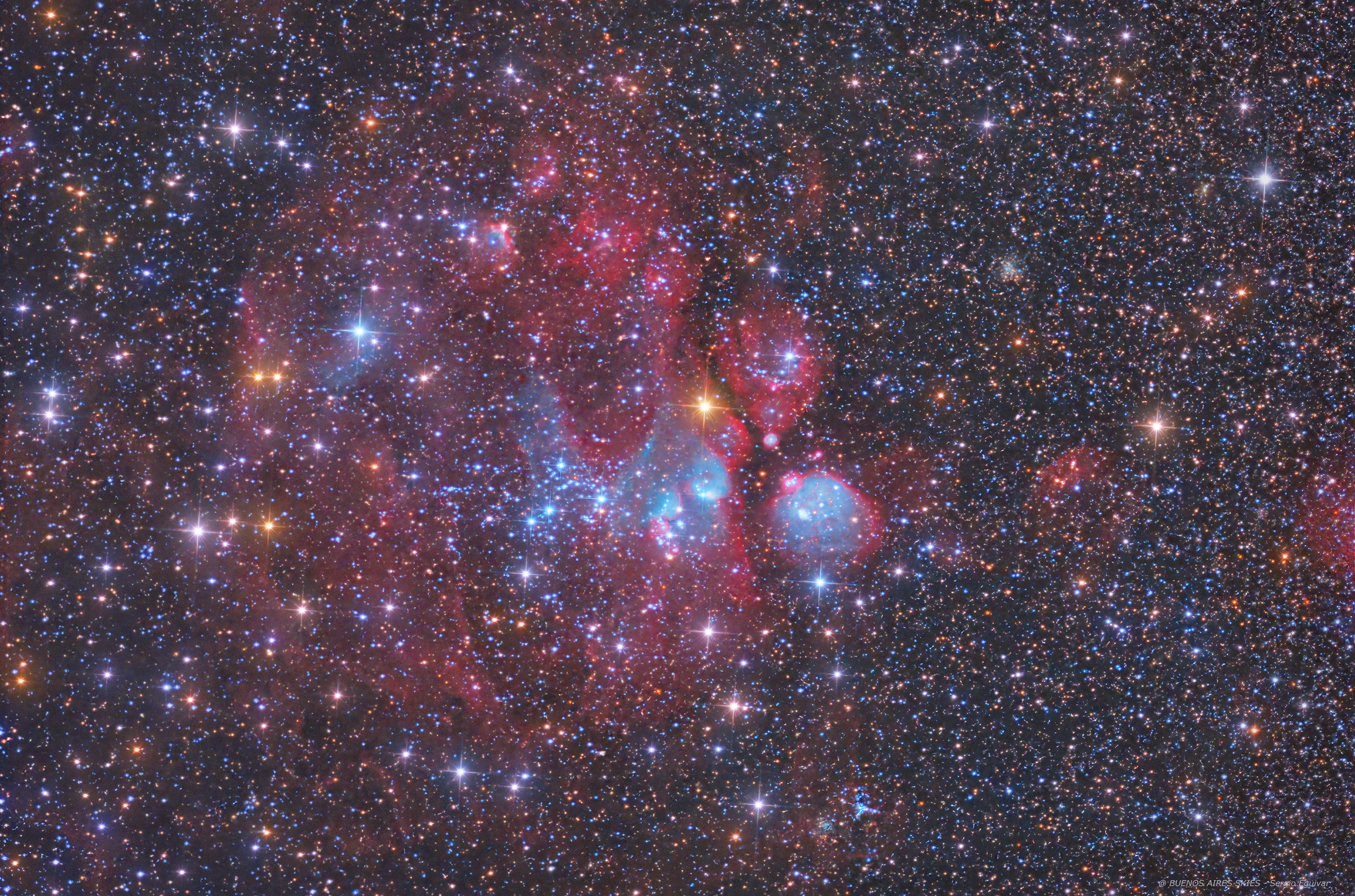
NGC 460; NGC 456; NGC 465
YOUNG OPEN CLUSTER WITH NEBULOSITY IN THE SMALL MAGELLANIC CLOUD IN TUCANA (THE TOUCAN)
(Image centred at: ra 01h:15m / dec -73º 06')
ANNOTATED IMAGE 100% RESOLUTION
AUGUST 2026, Observatorio Cielos Albertnos, Buenos Aires, Argentina
DATA
TYPE: Open Cluster with nebulosity
APPARENT DIAMETER: NGC 460 2.6 arc minutes; NGC 465 2 arc minutes
APPARENT MAGNITUDE (V): 12.5 (v)
DISTANCE: 200.000 light years
IMAGE INFORMATION
INSTRUMENT: Orion Optics UK 6" Newtonian with Ultra Grade Optics working at f 4.5
CAMERA: QHY 183 Mono Camera
MOUNT: VIXEN GPDX Guided off axis with QHY 5II Mono Camera
FILTERS: Antlia LRGB Set
SKY CONDITIONS: Bortle 3 to 4 skies
OBJECT DESCRIPTION AND IMAGE SESSION
NGC 460 is located in a region of the Small Magellanic Cloud, our neighbor galaxy that orbits the Milky Way. This particular region contains a number of young star clusters and nebulae of different sizes ― all likely related to each other. The clouds of gas and dust can give rise to stars as portions of them collapse, and radiation and stellar winds from those hot, young bright stars in turn shape and compress the clouds, triggering new waves of star formation.
The hydrogen clouds are ionized by the radiation of nearby stars, causing them to glow. The NGC 460 star cluster resides in one of the youngest parts of this interconnected complex of stellar clusters and nebulae, which is also home to a number of O-type stars: the brightest, hottest and most massive of the normal, hydrogen-burning stars (called main-sequence stars) like our Sun. O-type stars are rare ― out of more than 4 billion stars in the Milky Way, only about 20,000 are estimated to be O-type stars.
The area that holds NGC 460, known as N83 (Henize 83), may have been created when two hydrogen clouds in the region collided with one another, creating several O-type stars and nebulae.
Open clusters like NGC 460 are made of anywhere from a few dozen to a few thousand stars loosely knitted together by gravity. Open clusters generally contain young stars, which may migrate outward into their galaxies as time progresses. Because it is both close and bright, it offers an opportunity to study phenomena that are difficult to examine in more distant galaxies.
NGC 460 was possibly observed on August 1, 1826, by James Dunlop, though it was officially discovered on April 11, 1834, by John Herschel.
Dreyer described it as "very faint (in Nubecular Minor)," with Nubecular Minor referring to the Small Magellanic Cloud.
NGC 460; NGC 456; NGC 465
YOUNG OPEN CLUSTER WITH NEBULOSITY IN THE SMALL MAGELLANIC CLOUD IN TUCANA (THE TOUCAN)
(Image centred at: ra 01h:15m / dec -73º 06')
100 % RESOLUTION - image Croped
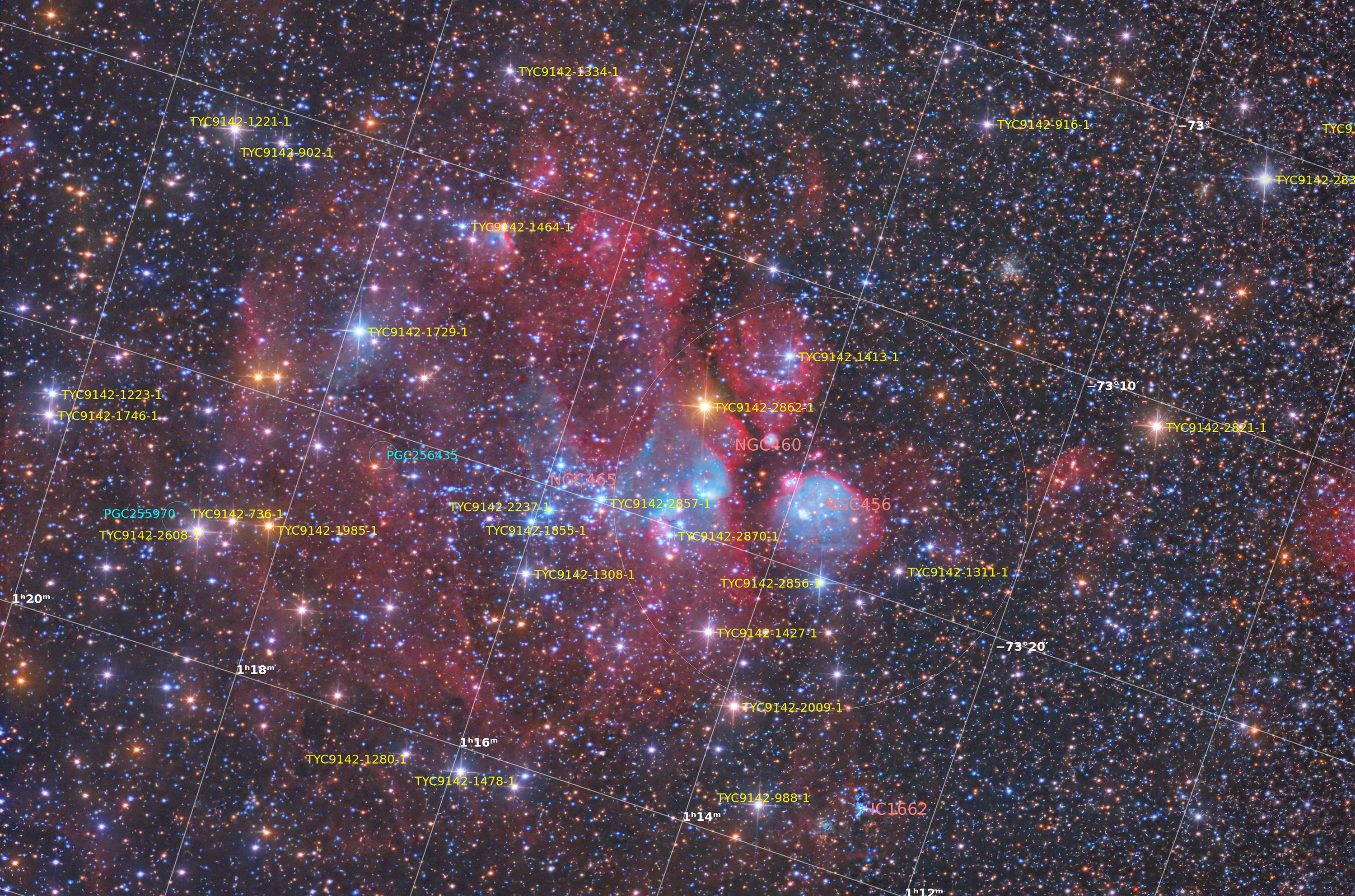
Image Plate Solver script version 5.6.2
===============================================================================
Referentiation matrix (world[ra,dec] = matrix * image[x,y]):
-1.92432091e-04 -6.53184421e-05 +6.53738928e-01
+6.52043065e-05 -1.92443914e-04 +1.73735640e-01
WCS transformation ....... Linear
Projection ............... Gnomonic
Projection origin ........ [2772.002349 1842.002291] px -> [RA: 1 14 01.504 Dec: -73 19 37.09]
Resolution ............... 0.732 arcsec/px
Rotation ................. 18.727 deg
Reference system ......... ICRS
Observation start time ... 2026-08-09 06:51:44 UTC
Observation end time ..... 2026-08-09 06:54:44 UTC
Geodetic coordinates ..... 58 31 05 W 34 29 19 S 50 m
Focal distance ........... 676.71 mm
Pixel size ............... 2.40 um
Field of view ............ 1d 7' 35.6" x 44' 55.0"
Image center ............. RA: 1 14 01.505 Dec: -73 19 37.09
Image bounds:
top-left .............. RA: 1 23 02.596 Dec: -73 08 27.32
top-right ............. RA: 1 08 26.461 Dec: -72 47 13.01
bottom-left ........... RA: 1 19 58.112 Dec: -73 51 25.33
bottom-right .......... RA: 1 04 49.356 Dec: -73 29 17.22