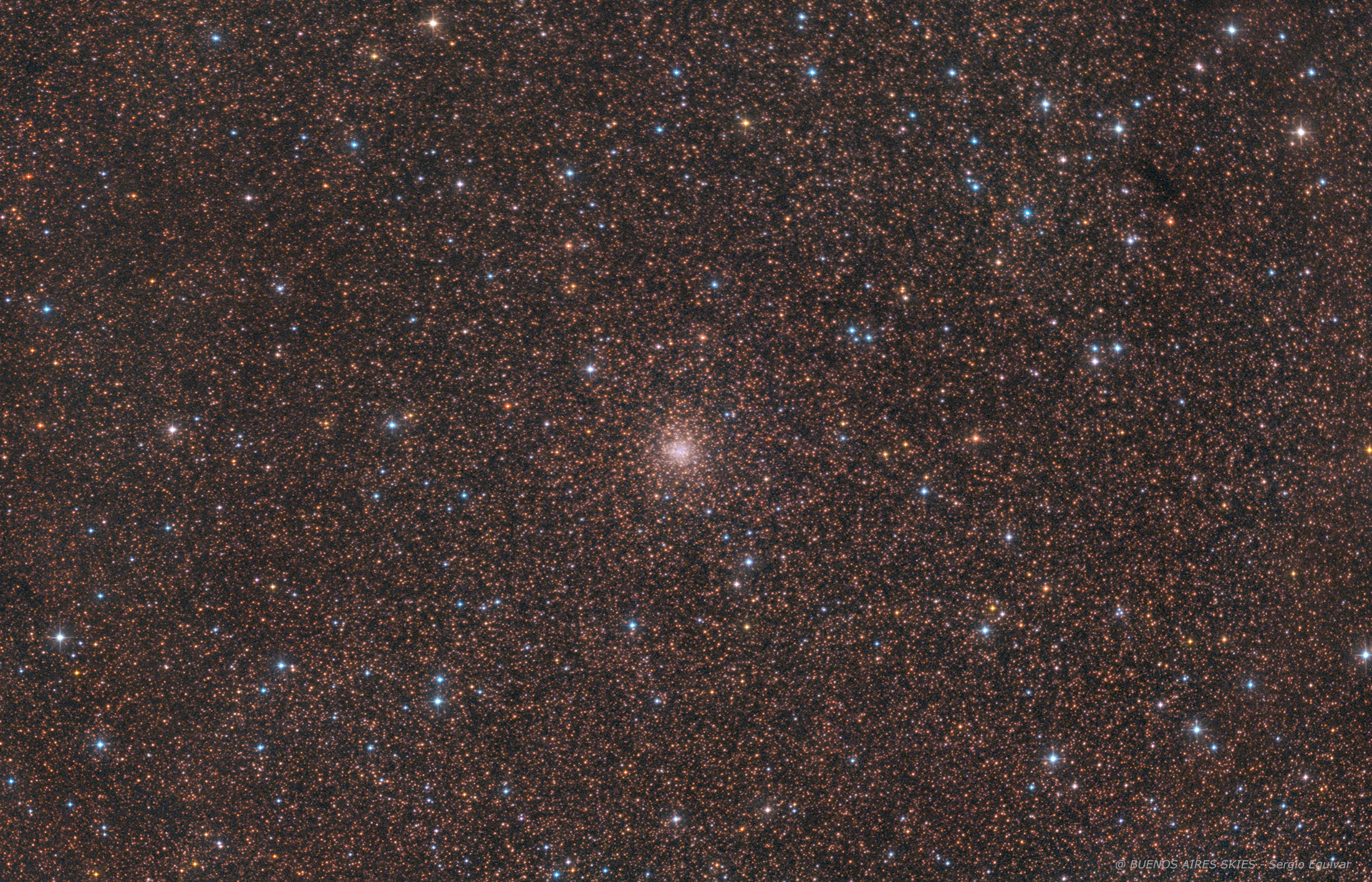
NGC 6304 is a relative small Globular Cluster located a bit more than two degrees south from the Pipe Nebula. This Globular is rich in metality since it has a remarkably high abundance of elements heavier than Helium. Because of its position near the Galactic centre, gas and dust heavily scatter its light, creating a strong interstellar "reddening" effect that complicates optical viewing. As a result, projects like the bulge Cluster APOgee Survey (CAPOS) rely heavily on near-infrared observations to study its stars. It is an ancient system estimated to be roughly 12.3 billion years old.
NGC 6304 was discovered by German-British Astronomer William Herschel in 1786 using a 18,5 inches (47 cm) f13 speculum reflector telescope